
Transmission #008 - Zapad and zapped
If the past is prologue, the omnipotence satellites have bestowed on the U.S. military is over.

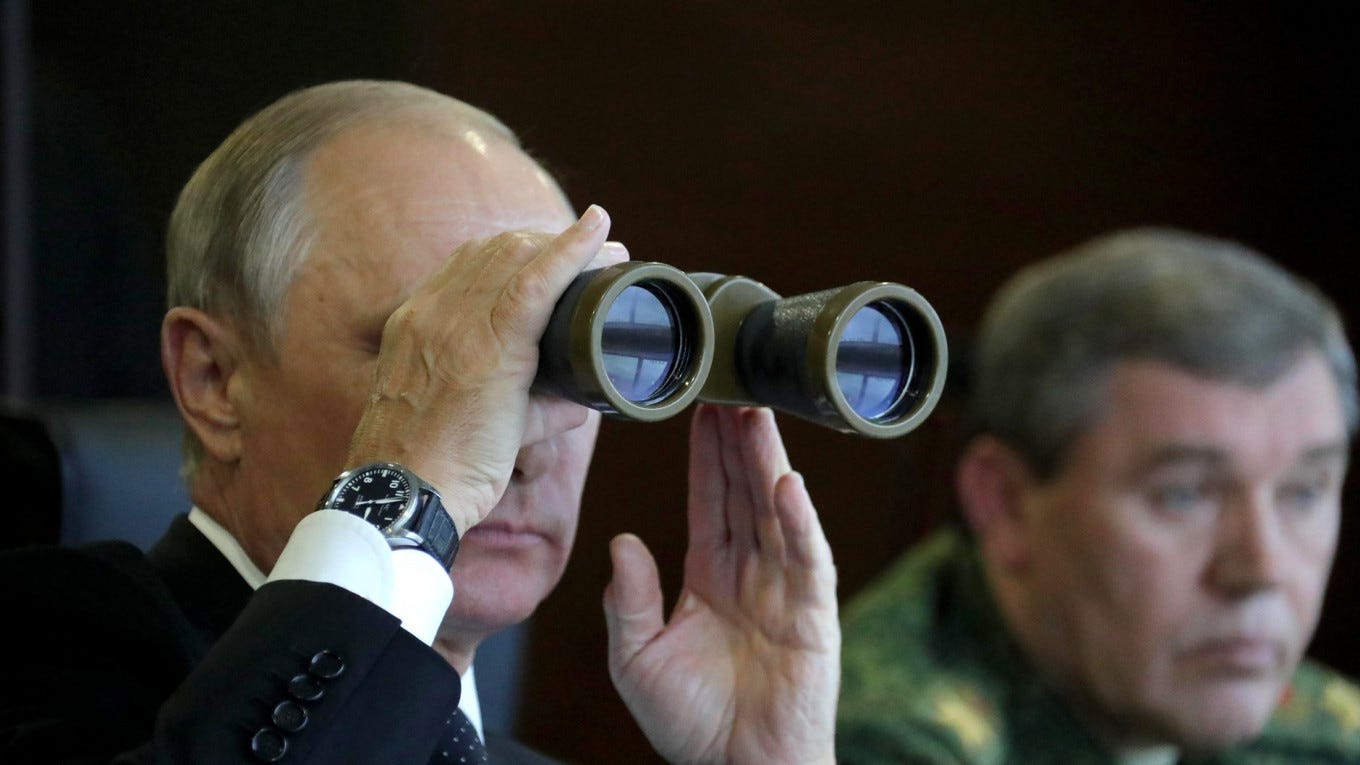
While we are all otherwise engaged with the 20th anniversary of 9/11 and COVID-19, some 200,000 Russian and Belarusian soldiers, sailors, airmen, and civilian defense officers have mobilized and deployed to Russia and Belarus’s western border with the European Union for war games.
Buckle up, Europe. It’s Zapad 2021!
If the past is prologue, U.S. and Allied space-based and space-dependent assets may be getting zap-ed in these exercises. Some experts and practitioners believe the era of United Sates’ satellites bestowing omnipotence on its military, in terms of gathering and analyzing, transmitting and receiving information, and targeting is over.
It is Zapad?
I get it. It sounds like something you’d say when a flying insect hits an electric bug incinerator. Instead, Zapad, which literally translates as “West,” is the name of Russia’s quadrennial war games on its western frontier. In the intervening years, the annual exercises are split between Vostok (East), Tsentr (center), and Kavkaz (Caucasus).
According to TASS, Zapad 2021’s week-long “active phase,” started Friday and is taking place on nine practice ranges in Russia’s Western Military District and also in Belarus on five training grounds. The Jamestown Foundation’s Roger McDermott, citing a Russian-language report, wrote that in addition to 15 warships, 80 aircraft and helicopters, and 290 tanks, Russia will also use its newly unveiled Tsirkon (Zircon) hypersonic missiles.
Geographically, Zapad 2021 is happening, starting from the north going south, along the land and sea borders of Norway, Finland, Denmark, Estonia, Latvia, Lithuania, and Poland. The reported number of personnel taking part is twice that of Zapad 2017 and could be the largest wargames on the E.U. border to date.
The space angle
It is not yet clear whether Russian forces are putting any of their cyber and anti-satellite capabilities through the paces like the last Zapad exercises in 2017. The Centre for Eastern Studies in Poland claims information operations started last October when the games’ dates and Belarusia’s participation were officially announced.
All three capabilities can and do touch commercial, civil, or defense satellites - as a throughput, a target, or a weapon. America’s peer adversaries know that these satellites guide precision munitions, have prying eyes and sensitive ears, and connect video calls to home or to the White House Situation Room.
Ever since the 1991 Gulf War, the U.S. military has relied heavily on what many analysts and users call an outdated “patchwork of networks and datalinks.” The U.S. Department of Defense is working to modernize its satellite constellations and its networks to better serve users, from strategic planners to shooters - to unify the system into some kind of manageable order.
The problem is, as some former policy-makers see it, the DoD needs to plan for the chaos that the U.S. and NATO Allies and partners have already had a taste of in the recent past.
Like what you’re reading? Click the button and subscribe!

The past was a cold appetizer
In August 2017, two weeks before the last Zapad “active phase” kicked off, a Russian cyberattack reportedly took down part of Latvia’s cellphone network for seven hours. The day before the “active phase” Latvia’s emergency services' 112 hotline was offline for 16 hours.
At roughly the same time Norway’s government-owned radio and television public broadcasting company, NRK, reported that airplanes in the country’s eastern airspace were unable to receive the Global Positioning System’s satellite signals for navigation. The Norwegian Space Center ruled out solar storm interference.
Someone - not in orbit - was jamming the usually ubiquitous signal coming from the GPS satellites, which are U.S. Department of Defense-owned and now operated by the U.S. Space Force. Norway’s National Communications Authority determined a jamming signal had originated from a location east of Kirkenes, a northeastern Norwegian town, a mere 15-minute drive from the Russian border.
Here’s a great time-lapse graphic from CSIS showing jamming disturbances.
Does anyone have a map?
Estonia’s then Commander of the Military Intelligence Centre, Col. Kaupo Rosin told DefenseNews's Aaron Mehta in November 2017, two months after the games concluded, “The exercise basically [addressed] two factors. First, how to jam the enemy, which is logical; and second, how to operate [within those] conditions themselves.
“They of course know that an electronic field is both a challenge for them and a possibility, since Western militaries are very dependent on different electronic communications, reach back and so on,” Rosin said. “You need different skills, procedures, and so on to conduct a successful war under those [circumstances]. You have to learn how to command your military with a paper map.”
The Allied experience
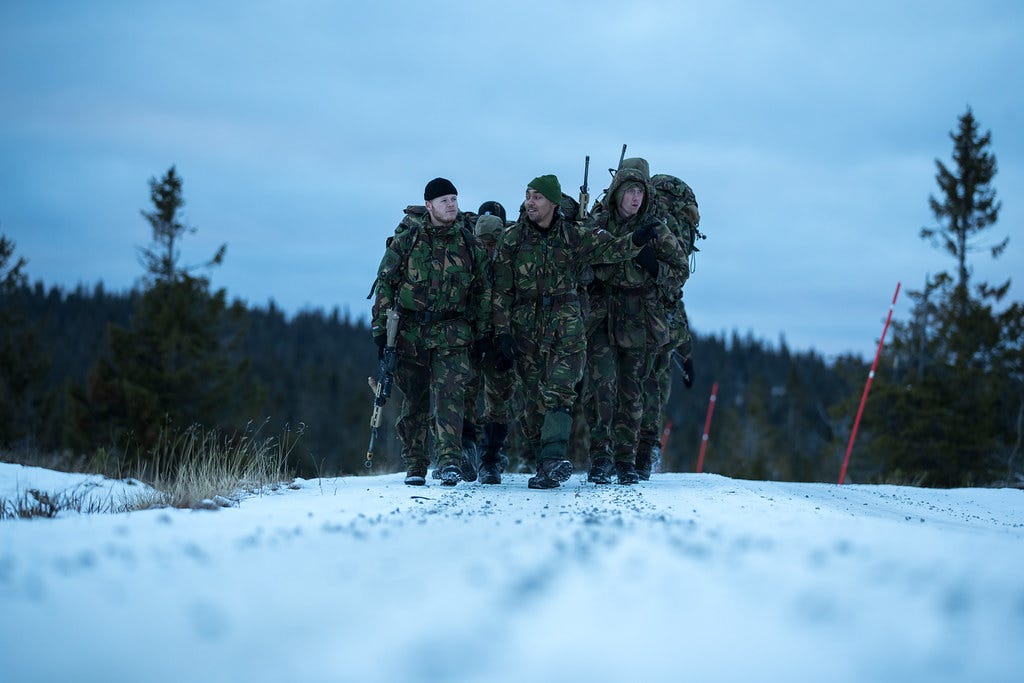
Fast-forwarding a year to November 2018, the NATO Alliance received an unwanted opportunity to test its command, control, and communications capabilities while being jammed during the wintertime Trident Juncture wargames in Europe’s High North. The Allies pointed to Russia as the source of the satellite signal disturbances.
Uninvited jamming activities cut both ways, and not just in terms of finding your way in the snowy-sleety fog. All Trident Juncture participants - official and uninvited - likely learned a lot about each other’s possible capabilities and exploitable weaknesses.
It would also be unwise to assume that the United States and its allies somehow gallantly resist the urge to jam up their adversaries. The difference here is authoritarian regimes need their populations to believe in the state’s ability to maintain order and security. Such a regime will not readily admit to being vulnerable to the chaos of satellite signal loss.
Creating order under a “dominance” policy
Wednesday, two days before Zapad 2021’s active phase, at Satellite 2021, an industry conference and trade show in Washington, D.C., Brig. Gen. Robert Collins, the program executive officer for Army Command, Control, and Communications – Tactical, said that the U.S. Army is working to unify logistics, communications, and intelligence networks, “So that we can more seamlessly traverse information.
“The big idea is how do we achieve decision dominance [the ability to gather trustable information, and to make better decisions faster than an adversary]? And we think that we do that by unifying our network… to make us more lethal in the future,” he said.
Writ large, the networks Collins is unifying into a “network of networks,” exist because of radio signals to, through, and down from satellites to ground stations or receivers anywhere the U.S. military has a footprint or a wake around the world. Like Waze works on your iPhone, just a way lot bigger, with a bazillion sensors, and more raw data than I think anyone has ventured to guess.
Operating a federation in chaos
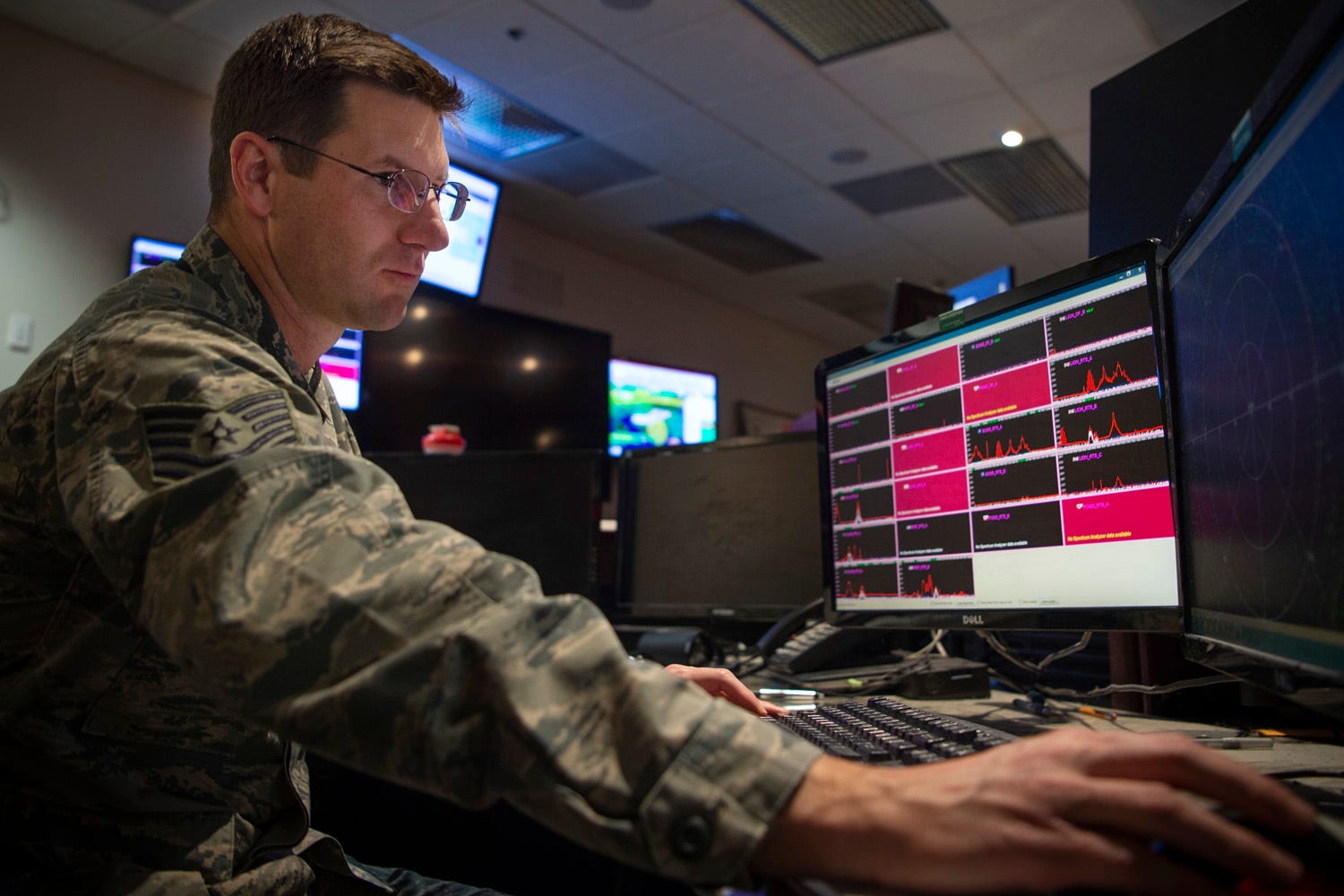
The question is will such a command, control, and communications network of networks actually work, let alone achieve dominance, in a jammed-up chaotic and contest battlespace? Chris Dougherty, a Center for a New American Security senior fellow, thinks not.
On Thursday Dougherty wrote in War on the Rocks, “The Pentagon should accept that the post-Gulf War era of imagined U.S. information dominance is over.” The DoD “should seek information advantage by being able to operate with degraded systems more effectively than America’s opponents.”
Dougherty wrote that the DoD should build a “confederation of smaller networks capable of operating independently… The fundamental design principle of this system should be functioning locally when Chinese or Russian attacks degrade long-range [satellite] connectivity.”
Some in the space industry agree with Dougherty. Jay Chapman, a retired U.S. Army colonel, and Director of Government Solutions for Iridium Communications, which owns some 66 active satellites, likes to use the word “federation” to describe what he thinks will best serve the warfighter.
Sitting next to Collins, Chapman told the Satellite 2021 audience, “No single network is going to do it all for DoD. I mean there’s a role for everybody. LEO [low-earth-orbit], MEO [middle-earth-orbit], GEO [geosynchronuous-earth-orbit], L-band, C-, K-, X-, LTE, fiber [optic cable]… We’ve got to find a way to federate everything that’s out there. There’s a lot of infrastructure in place.”
And the Russians?
Early last month the Kremlin began the arduous task of laying 12,650 kilometers (7,860 miles) of undersea fiber-optic cable over Russia's long Arctic coast. This infrastructure work started at a point that is a five-hour drive east from the Norwegian border at the Barents Sea village of Teriberka. When finished, the endpoint will connect to the far eastern port of Vladivostok.
Random Signals
Is this the beginning of SpaceBnB? In three days, sometime after 8 p.m. EDT on September 15, and weather permitting, a SpaceX Crew Dragon will take the charter Inspiration 4 mission’s four civilians up and into orbit for a three-day stay. As this is a charter, the billionaire paying for the launch is Shfit4Payment CEO Jared Isaacman, who is raising money for St. Judes Children’s Hospital. You can watch all SpaceX launches here.
China wants to study how to build a spacecraft that is more than half a mile long. The National Natural Science Foundation of China is calling for feasibility-study proposals that could be worth $2.3 million over five years. Former NASA chief technologist Mason Peck told Scientific American that building such a craft is “entirely feasible.”
France has joined the United States and Japan as states that are engaging in bilateral space security talks with India. India is the first Asian country with which France has started space security talks. For a breakdown on why this is an important development, read Rajeswari Pillai Rajagopalan’s piece in The Diplomat.