Transmission #009 - Increased access - increased risk
What’s gotten up the exhaust nozzles of national security officials as getting into space gets easier and cheaper?

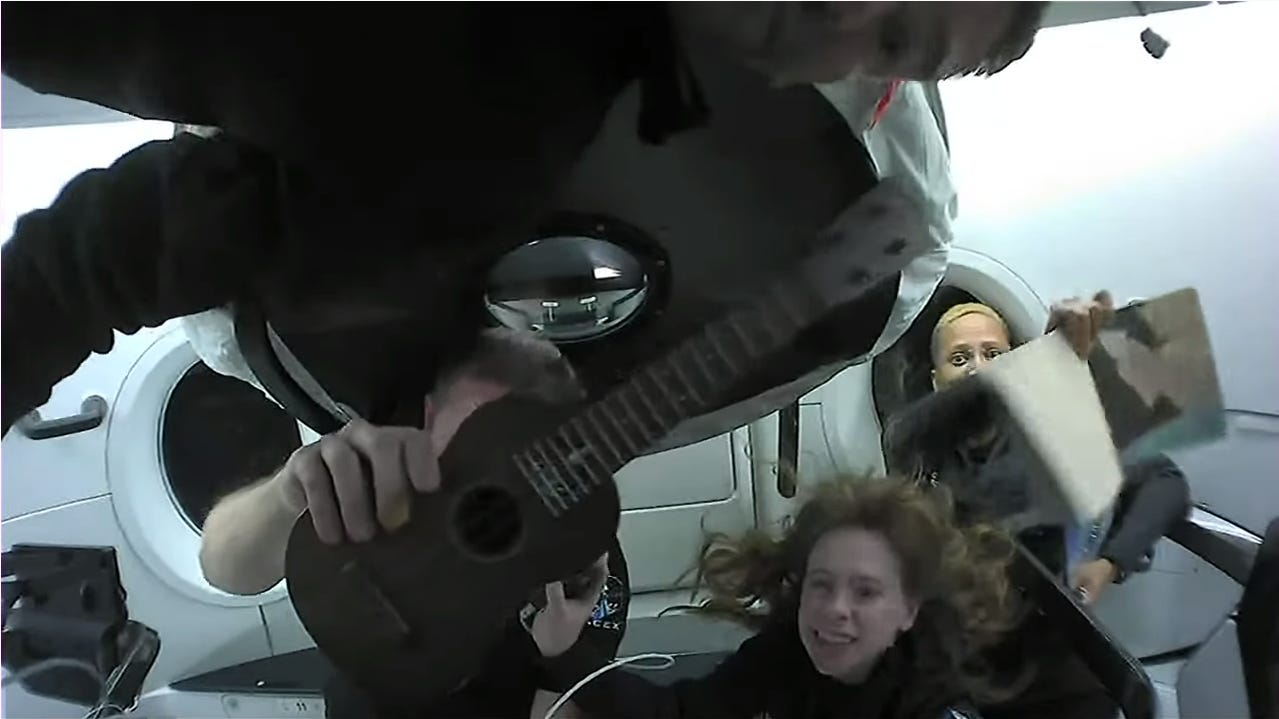
On Wednesday night there were 14 humans in orbit - breaking the previous record of 13 set more than a decade ago in 2009. Check with the bookies. Odds are this record is going to be broken in months, rather than years.
The 14 were the Inspiration 4’s four, plus the seven on the International Space Station, and the three aboard Shenzhou-12, who by the way just finished up their three-month stint on China’s Tianhe space station. After 90 days in space, Nie Haisheng, Liu Boming, and Tang Hongbo on Friday landed in the Gobi desert tenuously holding the record for the longest stay in space by any taikonaut.
Until this July sending humans to space had been an entirely national government endeavor. The costs of going up have come down, so much so that now a billionaire like Shfit4Payment CEO Jared Isaacman can fundraise for St. Judes Children’s Hospital by chartering a SpaceX Crew Dragon for the gravity-free glamping mission Inspiration 4. Isaacman and his crew of three ate cold pizza, played the ukulele, and slept in tethered floating sleeping bags. They returned to earth on Saturday.
As more humans are going or sending tens of thousands of satellites into orbit, arguments for “norms of behavior” - rules by any other name - have escalated to a steady percussive beat. Even the chief of Britain’s new Space Directorate this week warned that without agreeing to some form of space rules we could see terrorism in space.
What’s gotten up the exhaust nozzles of national security officials
“We all have witnessed what happens, and what particularly happens when the air domain became accessible to all — terrorists turned airliners into weapons,” said Air Vice Marshal Harvey Smyth at the Defence and Security Equipment International, a biennial defense and security trade exhibition. He said, “If such a trend holds true for space, when will we have to deal with our first example of space terrorism?”
Rules are few in space, and like records, they get broken. What can also be vexing is deciphering whether the aberrant behavior is benign or actually an act of aggression?
“What are the norms of behavior?,” the United States Space Force Chief of Space Operations Gen. John "Jay" Raymond figuratively asked the New America’s Future Security Forum 2021 on Monday. “We have to figure out what is safe and professional as it relates to the space domain like we have in the air domain, like we have in the maritime domain.”
The benign-ish billionaires
Billionaire entrepreneurs now own launch companies that are inspiring other billionaires as well as actors and filmmakers (see Random Signals below) to go to spaceports, bringing a bevy of benign-ish headaches with them.
When Sir Richard Branson’s Virgin Galactic VSS Unity-22 launched him and his crew of five in July, it bust wide open what since Yuri Gagarin’s 1961 launch had been the near-exclusive province of national space agencies and their contractors, test pilots, and “civilian” scientists and engineers. But shortly after returning to earth the Federal Aviation Authority grounded Sir Richard’s luxury space tourism company Virgin Galactic.
Branson’s voyage only lasted 90-ish minutes, topping out at an altitude of 85 km, short by 15 km. of the Kármán Line - the internationally recognized edge of space. The some 600 reservations for the $250,000-seats to near-space are on hold until the FAA concludes its investigation into why the pilot ignored a red warning light and veered off the pre-approved course.
In the United States there are rules but they end at the borders, including the one marking the edge of space.
Sort of benign stuff
In orbit factoids: Active – Derelict – Debris. Video: AGI
As of Thursday, there were 7,951 satellites in orbit, the most ever in LEO (low-earth-orbit), MEO (middle-earth-orbit), and GEO (geosynchronous-earth-orbit). Last year we launched a record 1,300 satellites. Only nine months into 2021 we’ve already blown well past that mile-marker, with at least 1,400 new satellites having been added to the inventory.
“The concern is: do you have a situation where you’re not managing your satellites properly and you have so many of them that you absolutely bump into each other?” Maj. Gen. DeAnna Burt, vice commander of Space Force Space Operations Command told the Advanced Maui Optical and Space Surveillance Technologies Conference on Wednesday, as reported by Theresa Hitchens in Breaking Defense.
Thursday, Supriya Chakrabarti, a University of Massachusetts Lowell physics professor wrote on The Conversation Thursday, “As low-Earth orbit gets crowded, concern about space debris increases, as does a real possibility of collisions.” She concluded, “Every disruptive technological advancement requires updates to the rules – or the creation of new ones.”
Like what you’re reading? Click the button and subscribe!
The not-so-benign stuff
We have a trash problem. Space companies, agencies, and militaries are tracking debris ranging from frozen urine crystals to rocket stages to derelict satellites, whizzing around in LEO with multimillion-dollar functional satellites at roughly 8 km. a second. That’s 25 times faster than a 9mm. bullet shot from a Beretta pistol.
“We need to pick up debris — we need trash trucks. We need things to go make debris go away,” Burt said.
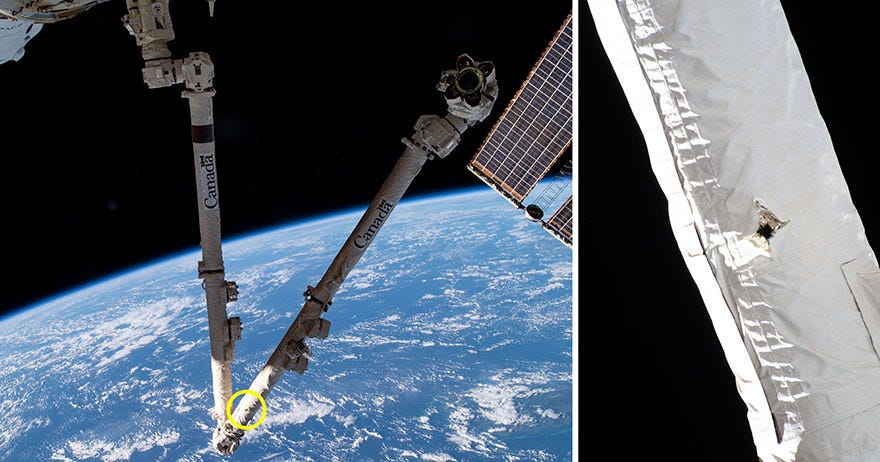
In May astronauts discovered a hole in the ISS’s $100m robotic arm that the Canadian Space Agency attributes to a “lucky strike” by a piece of space junk. The European Space Agency believes there are about 34,000 tennis-ball-sized junk objects, with roughly 129 million objects 10cm and less.
Of course, the best way to prevent litter in any open space is to take out what you take in. International guidelines call for deorbiting dead satellites in LEO within 25 years of the lights going out, so that they burn up in the atmosphere. NASA’s Office of Inspector General found “the global compliance rate has only averaged between 20 to 30 percent.”
So as national laws and norms have borders, if a satellite - derelict or not - smashes into another accidentally the 1967 Outer Space Treaty, to which most nations are signatories, applies. In simple terms, if your satellite or piece of attributable junk slams into someone else’s, your national government is held liable for damages. You can be sure the government will collect on that bill.
So what counts as aggressive or an act of war?
On Monday I asked Raymond, “In the absence of agreed norms of behavior, what space-based behavior is aggressive but benign, and what sort of behavior in space would be considered an act of war?”
His answer: “The challenge with that is it’s hard to tell.”
This is not an abstract query. Russia launched a “nesting doll” satellite in 2019, that once in LEO released a “sub-satellite” that cozied up to and mirrored maneuver-for-maneuver a bus-sized U.S. spy satellite. The sub-satellite then released another object, which so far has done nothing.
Raymond, who was attending the New America conference virtually, continued by explaining, “Let’s say you wanted to go up and refuel a satellite on orbit. The ability to refuel a satellite on orbit could be very benign.
“At the same time if you have the ability to refuel a satellite there’s probably an aggressive tactic that can be taken as well. And that’s one of the challenges that we see in the domain, as the domain is dual-use, a lot of the things that might to some be benign, taken another way could be aggressive,” he said.
Random Signals
It seems that not all invitees to Dmitry Rogozin’s red-carpet October 5 launch of movie star Yulia Peresild and film director Klim Shipenko into space have RSVP’d. Elon Musk, the SpaceX founder, hasn’t accepted the invite from the head of Russia’s space agency Roscosmos. Rogozin, who self-identifies as a Musk frenemy, is a former diplomat who was assigned the Roscosmos portfolio after landing on the U.S. sanctions list when Russia annexed Crimea in 2014.
Rogozin is sending the duo to the ISS to film scenes for The Challenge, a movie he is co-producing. Because the actress and filmmaker are not staying on as replacement crew, astronaut Mark Vande Hei and cosmonaut Pyotr Dubrov have extended their six-month mission by another six months.

Arnaldo Méndez and Yuri Romanenko. Image: Roscosmos Yesterday, September 18, marks the 41st anniversary of the first Black person to launch into space. On September 18, 1980, aboard a Soyuz rocket, cosmonaut Arnaldo Méndez, also became the first Cuban and Latin American to reach orbit. Jon Kelvey authored a thought-provoking feature on Inverse.
South Korea’s government is giving its domestic space industry a leg up. It announced that next year it plans on transferring state-owned space launch vehicle technologies from the Korea Aerospace Research Institute to commercial entities to get into the commercial launch segment. If successful, the Korean companies would compete with the likes of SpaceX or Rocket Lab.
Apple Co-Founder Steve Wozniak has used Twitter on Monday to announce his new space company, Privateer Space. The business case is anything but clear. CNET seems to believe Wozniak is going into the space junk and clean-up business.
Something slammed into Jupiter and exploded on Monday, September 13, and astronomer and space photographer José Luis Pereira captured images of the rare event. You can check out more of his photos on Flickr.
 Paul Byrne@ThePlanetaryGuySomething hit Jupiter yesterday. Brazilian astronomer José Luis Pereira detected an impact flash (the subtle white splotch in this gif) on the giant planet Sept. 13. Will follow-up observations reveal damage to the atmosphere? (GIF processed by Marc Delcroix, h/t @peachastro)2:50 PM · Sep 14, 20211.2K Reposts · 3.82K Likes